THE ROAD TO LIFE ARCHITECTURE

Many dots. One thread.

Every career can look like a collection of unrelated decisions.

Looking back, mine was not.

Physics. Technology. Business analysis. Transformation. Business architecture. Family. Life design.

Different chapters. The same way of thinking.

Begin the journey

JOURNEY

How the thread became a craft.

Many dots. One thread.

The road was never a perfectly planned ladder.

It emerged through curiosity, opportunity, mentors, experience and a habit of noticing patterns across different kinds of work.

Looking back, the individual decisions did not always appear connected. But the same instinct kept returning: understand the whole, find the structure beneath the noise and make complexity easier to navigate.

The dots were different. The thread was already there.
A lesson that shaped my thinking.

In my twenties, a CEO I worked with taught me a lesson that stayed with me: do not rush towards solutions.

First, understand the whole. Break complexity into clarity. Connect ideas systematically. Then decide what should change.

At the time, I saw it as practical professional advice. Only later did I realise it had become the way I approached almost every difficult problem.

Before solving the problem, learn to see the system.

Structured thinking became a craft.

As a business analyst, I worked across manufacturing, airlines, telecommunications, insurance and consulting.

Each industry had its own language, operating model, processes and technologies. Yet beneath those differences, I kept finding familiar patterns: unclear objectives, disconnected decisions, competing perspectives and solutions introduced before the underlying problem was understood.

Working across different environments taught me how to ask better questions, map complexity, connect strategy with execution and translate between people who saw the same system from different angles.

Structured thinking gradually stopped being only a professional skill.

Through repeated practice, it became a craft.

From business analysis to business architecture.

Moving to Japan placed me in a new country, language and working environment, while allowing me to continue building my career in the insurance industry.

Over time, my perspective expanded. I moved from analysing individual requirements and solutions towards understanding broader business systems: strategy, value streams, capabilities, operating models, information, people and technology.

Business architecture gave a more complete language to something I had been practising for years—the discipline of seeing the whole and maintaining alignment across it.

If organisations need architecture to remain aligned, why do we rarely apply the same thinking to our lives?

Becoming a father changed the question.

The birth of my children quietly changed the way I thought about success.

Career progression and financial security still mattered, but they no longer felt sufficient on their own. I began thinking more seriously about time, health, presence, memory and the life my family was building together.

I also started asking questions for two different futures: the person I would eventually become, and the lives my children would one day build for themselves.

Questions emerged that no conventional career plan could answer:

What kind of memories are worth creating?

What choices should freedom make possible?

What kind of father do I hope they remember?

What might I pass on beyond money?

The question was no longer only how to build a career. It was how to build a life.

Can life be designed?

By then, I had spent years helping organisations understand complexity through business analysis, transformation and business architecture.

Yet I had never applied the same discipline fully to the person making my own decisions: myself.

I began wondering whether the methods used to clarify organisations could also help people understand their lives more holistically.

Could structured thinking reveal imbalance before it became regret?

Could architecture connect everyday choices with long-term purpose?

Could a clearer view of the whole help us make decisions with greater confidence?

If life cannot be controlled, perhaps it can still be understood, designed and continuously realigned.

Still unfolding.

I am still exploring the answer.

The frameworks I am building, including the Happiness Equation, are evolving attempts to see life more clearly, understand it as a connected whole and remain aligned with what matters through different seasons of life.

My hope is that these ideas can eventually help people:

  • see their lives with greater clarity and confidence;
  • understand the relationships between different parts of life;
  • make better decisions without losing sight of the whole;
  • maintain alignment as circumstances, priorities and identities change.

If these frameworks help someone filter out noise, recognise what matters and take one more intentional step, then sharing them is worthwhile.

The frameworks are still evolving. So is the life they are helping me design.

We spend years learning how to build a career, but very little time learning how to design a life.

That is the question I am still exploring.

THE JOURNEY CONTINUES

From questions to frameworks.

The questions from this journey are gradually becoming practical frameworks for thinking, decision-making and life design.

Explore the frameworks →

VISUAL NOTE

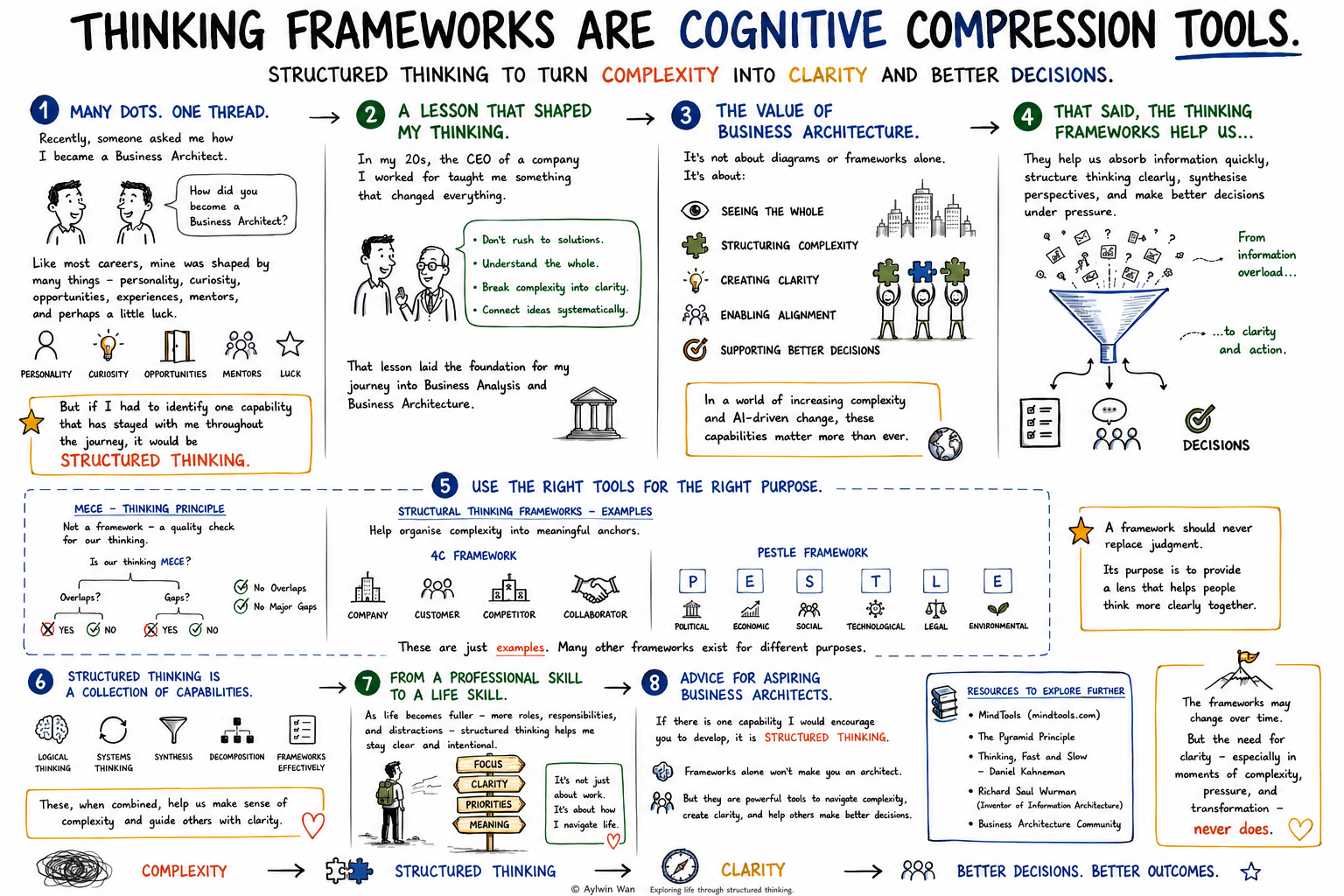
Thinking frameworks are cognitive compression tools.

The visual below is the working sketch behind this page. It shows how structured thinking compresses complexity into clarity—and clarity into better decisions.

THE WIDER QUESTION

The tools may change. The question keeps widening.

Business architecture was an important chapter, but life architecture became the broader question: how structured thinking might help people build lives with more clarity, freedom, memory and meaning.